The short answer: a tank water heater wins on upfront cost and simple like-for-like replacement, while a tankless unit wins on endless hot water, energy efficiency, and service life. For a Brandon, FL family that keeps running out of hot water, or wants the garage floor space back, tankless usually pays off over time. For a budget-driven straight swap, a quality tank still makes good sense. This guide compares the two side by side on cost, lifespan, energy use, and capacity, then helps you decide which fits your home.
Here is how the two types stack up on the factors that matter most for a Brandon home:
| Factor | Tank Water Heater | Tankless Water Heater |
|---|---|---|
| Upfront cost | Lower - simplest like-for-like swap | Higher - unit plus possible gas-line upsizing |
| Hot water supply | Limited to tank capacity, then a reheat wait | Continuous - rated in gallons per minute |
| Energy use | Reheats stored water all day, even unused | Heats only on demand |
| Space | Closet or garage floor footprint | Wall-mounted, frees the floor space |
| Typical service life | ~8-12 years (shorter in hard-water areas like Brandon) | ~20 years with regular descaling (manufacturer-typical) |
| Brands we install | State, A.O. Smith | Rinnai, Navien |
| Watch-out | Hard-water sediment shortens tank life | Gas units often need an upsized gas line - we install and pressure-test it |
A tank water heater stores 40 to 80 gallons of water and keeps it hot around the clock, ready for demand. When you draw hot water, cold water refills the tank and the burner or elements reheat it. That is simple and reliable, but the unit spends energy holding a full tank at temperature whether you use it or not, and once the tank empties during heavy use you wait for it to recover.
A tankless unit heats water only when a fixture calls for it. Water passes through a gas burner or an electric heat exchanger and comes out hot continuously, with no storage tank to refill or reheat. That is why tankless output is rated in gallons per minute rather than tank capacity: the question is not how much hot water is stored, but how much the unit can heat at once.
Tank heaters, like the State and A.O. Smith units we install, are the default for good reasons. The upfront cost is lower, the replacement is usually a straightforward like-for-like swap, and the technology is familiar to every plumber. If your current setup is a tank and your household hot-water demand is steady, a new tank is often the fastest, most economical fix.
The trade-offs: a tank spends energy keeping stored water hot even when no one is home, its capacity is finite so a big morning can drain it, and here in Brandon our hard water drives sediment to the bottom of the tank, which shortens its life. A water softener helps, but the fundamental limits of stored hot water still apply.
Tankless units, such as the Rinnai and Navien models we install, deliver continuous hot water and typically last around 20 years, roughly double a tank. They take up far less space because they mount on a wall, and because they only heat on demand, they avoid the standby energy loss of a tank. For a busy household that runs multiple showers back to back, endless hot water is the headline benefit.
The trade-offs are real too. The upfront cost is higher, and a gas tankless unit often needs an upsized gas line to feed its higher burner rate, which we install and pressure-test as part of the job. And in a hard-water area like Brandon, a tankless unit needs an annual descale to keep the heat exchanger clear of scale. If you want the details on a tankless install, see our tankless water heater installation in Brandon, FL page.
Start with three questions. How many bathrooms or fixtures run hot water at the same time? A large household that overlaps showers and laundry benefits most from tankless. What is your fuel type and gas capacity? A gas tankless unit usually needs an upsized gas line, which we handle. And what is your budget, both upfront and over the life of the unit?
If you want the lowest install cost and your demand is moderate, a quality tank is the right call. If you want endless hot water, a longer service life, and reclaimed floor space, and the upfront cost fits, tankless is worth it. Either way, hard water is the common enemy, so pairing the new heater with a water softener protects your investment. We install both types and handle water heater installation in Brandon, FL, and we quote both options in writing so you can compare them honestly.
Tank wins on upfront cost and simple like-for-like replacement; tankless wins on endless hot water, energy efficiency, and service life. For a Brandon family that regularly runs out of hot water - or wants the garage space back - tankless usually pays off. For a budget-driven straight swap, a quality tank still makes sense.
A tankless unit heats water only when a fixture calls for it: water passes through a gas burner or electric heat exchanger and comes out hot continuously, with no storage tank to refill or reheat. That's why tankless output is rated in gallons per minute rather than tank capacity.
Start with three questions: how many bathrooms run at once, your fuel type (gas tankless units often need an upsized gas line - which we install and pressure-test), and your budget. We install both - State and A.O. Smith tanks, Rinnai and Navien tankless - and quote both options in writing so you can compare.
We install State, A.O. Smith, Rinnai, and Navien water heaters and quote both a tank and a tankless option in writing. Call or text (813) 707-3215 for same-day service during business hours.
Book Now (813) 707-3215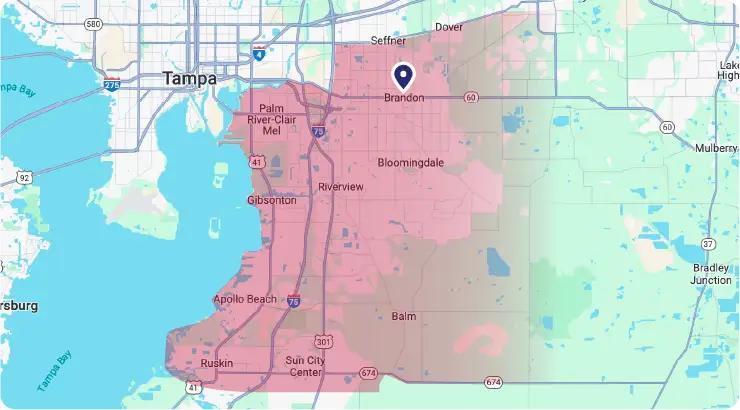
Our team of expert plumbers is ready to assist with all your plumbing needs in Brandon, FL and Eastern Hillsborough County.
Whether you're in need of a repair or planning a plumbing project, we're here to provide reliable, professional service.
Request Service Now
© Drainworks Plumbing & Gas Inc. 2026 | All Rights Reserved
Website by Red Barn Media Group